Less Math, More Dyeing
- Jessica Lambert

- Sep 26, 2020
- 6 min read
In my last post I showed you how I record and look up colorways that I have already dyed. In this post I will show you how I have simplified the math for myself when I am dyeing new colorways.
Anybody else out there surprised by how much math is involved in dyeing? At first there didn't seem to be too much to it. As a hobbyist, I guesstimated how much food coloring would be good and didn't have specific results in mind and didn't need to be able to repeat colorways. So I could just "splash around" as I like to say and not worry too much about being exact about things like depth of shade, saturation, ph, etc. But when I got my first few fiber reactive dyes, and then later acid dyes, with the intention of dyeing colorways of my own design that I would then sell I wanted to be much more precise. And that meant doing the math.
So much math. And not even fun math where you learning something new, just punching numbers into a calculator and writing down the results over and over. If I had a colorway I wanted to dye with say, four distinct dyes colors that would mean I had to calculate the amounts for each primary color I would need for each of the colors I was going to mix. This meant punching in 12-20 formulas into my calculator, and if I had more than one colorway to dye in a session that meant even more calculations before I could get started. Then suddenly I would see that I had put in the wrong values for something and I'd have to calculate that one over again. I was setting aside time for dyeing and then using it all to do math! Too often the actual dyeing part had to wait until another day because, with my lifestyle, I have to be able to be done when I say I will be done. I knew this was unsustainable for me. So I decided to build a tool that would do the math for me. And now I'm sharing it with you. Behold: The Dye Calculator!

(Click this link if you want to see it in on your own computer instead of just through my screenshots: https://docs.google.com/spreadsheets/d/1ReNIzRRVKYjglY4vHgBPbzaPvjbSL9alNS3dMJay-wQ/edit?usp=sharing )
I have made two versions of this. This one is a more versatile one for dyers who use primary colors and also those who just like to mix dyes, be they true primaries or no. I also have a version that I will get to in a sec that is specific to dyers using a CMYK based method.
But first let me show you how it works.
So the overview is that you input all your information about your colorway into the big and little blue charts at the top and then down in the yellow chart the amounts of each "primary" dye you will need for each color in your colorway will be automatically calculated as well as how much water to add to dilute it to the correct strength. (The green chart basically does the same thing but instead of giving you your amounts in milliliters of dye it gives you grams of dye powder.)
Now, Instead of spending hours doing math and double checking that I've got it right I can input some values that maybe takes five minutes at most and then I'm ready to dye! Which means I actually get to dye instead of waiting for the next time that I can magically carve out a few hours from taking care of four kids during a pandemic.
Sounds great, but how do I actually use it?
First let's look at the blue chart.

Here I've put in some values for a rainbow colorway. In the first column, I've named each color in the colorway. I like using letters because I have labeled all my dye applicator bottles this way and it helps me avoid mixing them up later on. But I could just have easily called them "Red" "Orange" "Yellow" "Green" "Blue" and "Purple". There's space for seven colors but I'm only dyeing six so "Color G" will be left empty. (If seven colors isn't enough for you, don't worry. It is very easy to add space for more)
In the "coverage" column I have entered in what percentage of the fiber will be covered by each color. So for this fictional colorway that I probably won't dye, I'm saying that I want each of the colors to get equal space which works out to be about 16%. But I could make it whatever I want. If the percentages add up to more than 100% the cell that says "coverage" will show red. Like so:

Next is "Saturation", This value is basically how deep you want the color to be. 100% will be a saturated bright hue, while 10% will be much paler. Basically 100% = 1% Depth of Shade. So you can go higher if you want something even more saturated. But you should get to know your dyes and your fiber as the dye bath may fail to exhaust if you go too high.
Finally for the large blue chart you have the percentages of your primaries. So since I'm doing a very simple rainbow I've started with 100% red for the first color and the 50/50 red and yellow to make orange for "Color B", then 100% yellow for "Color C" and so on. You do not have to use true primaries for these you can make them Whatever your dyes are actually called so for me I could rename them like this:
If you like to use more than four primaries have no fear! I'll explain how to edit this calculator in a future blog post. Though if you have ever used spreadsheets before you could probably figure it out on your own.
Once you have the percentages for all your colors filled in, all that's left is to enter in the total weight of your fiber and the DOS% (Depth Of Shade) of your primary dye stocks.

Basically this DOS % input is the number of grams per 100 milliliters in the dye stocks you are going to use. Make sure all your primaries are mixed at the same depth of shade, otherwise the calculator won't work.
Once you have filled out all the blue fields and double checked that they are correct you can refer to the yellow chart to mix your dyes!

So if I were to dye this colorway I would mix up 6 different dyes. In the first bottle I'd add 1.6 ml of my Red primary dye (which is at 3% DOS, because that's what I entered) and I would dilute it with 14 ml of water. In the last column, I have a value for Urea which you can use if you are hand-painting with fiber reactive dyes but if you aren't you can ignore that column. But we'll say I am using that method and so to my "Color A" dye bottle I'll add .8 grams of Urea. Then to the "Color B" bottle I'd add .8 ml of red dye stock, .8 ml of yellow dye stock, 14 ml of water and .8 grams of Urea. (Again, for most dye application methods you will not need Urea) I will then finish mixing the rest of my colors in this manner until I have them all ready. Once I am ready to apply the dyes I will refer to the chart again to remind myself how much of the yarn/fiber that much dye should be applied to. If it's meant to cover 16% and I spread it over 25% it will be much paler than I want.
On the other hand if I want to mix these as a powder I can refer to the green chart:

So for color A I would put .05 grams of red dye powder and 16 ml of water and this would give me the same result as if I mixed according to the yellow chart. It's just preference really. Most people mix from dye stocks but the option is there for you.
So that's pretty much it. This post has taken far longer to write than I thought it would so I think will wait until another day to show you the CMYK specific Dye Calculator. If that sounds interesting to you, stay tuned! Until then, enjoy this new tool. You can make it your own the same way as with the "My Colorway Catalog": Click here to get the template and then hit "File" and "Make a copy" to get own editable version. Of course you will need a google account as it is a Google Sheets spreadsheet. Thankfully those are free and most people already have one.
Once you have your own copy look down at the bottom and you'll notice some tabs:
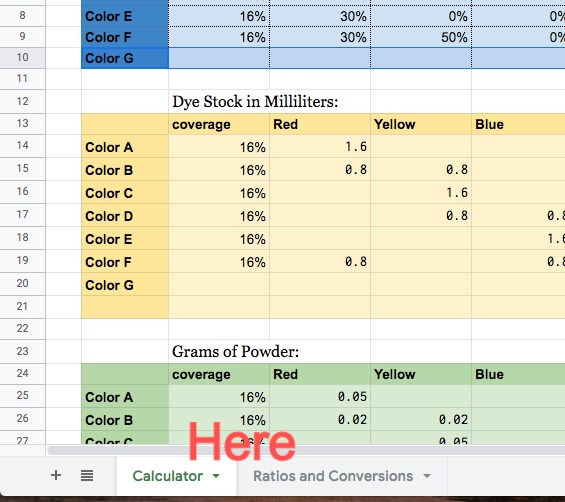
If you click that Ratios and Conversions Tab I've made for you some quick calculations for things like how much powder to mix into your primaries based on the DoS % and how much Citric acid to use and some other stuff, it's all labeled and easy to use: input blue, output yellow. There's a separate section for fiber reactive dyes so ignore that if you're strictly an acid dyer. Remember these are just guidelines, starting points. You may find you need more citric acid or you might have dyes where your yellow needs to be mixed at double strength. Experiment, learn, adjust your approach, have fun.
Happy dyeing!


Comments